
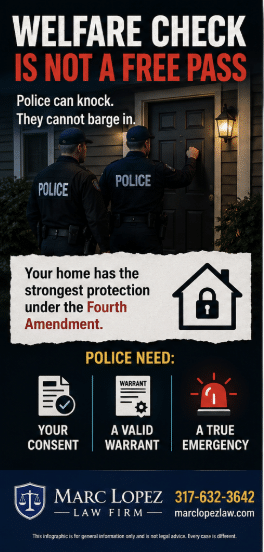
Generally, no. A welfare check does not automatically allow police to enter your Indiana home without a warrant. Police usually need your consent, a warrant, or a genuine emergency that legally justifies immediate entry.
What happens when someone calls police for a welfare check in Indiana?
Imagine you have a minor argument with a neighbor over a tree branch. Nobody gets hurt. Nobody makes a threat. You make your point and go back inside.
Your neighbor is still angry, so he calls 911. Instead of reporting a crime, he tells police you seemed agitated. He asks officers to conduct a welfare check.
A few minutes later, police are standing on your front porch.
That does not mean they can automatically come inside.
Police may approach a home and conduct what is commonly called a “knock and talk.” They can walk up, knock on the door, and try to speak with the occupant.
Think of it like the implied permission you give a delivery driver. The driver can walk to your door and knock. That does not give the driver permission to wander through your house.
The same basic principle limits police.
Do I have to open the door when police conduct a welfare check?
You generally do not have to open your door simply because officers want to speak with you.
Suppose you see the officers outside and decide not to answer. You know you have committed no crime, and you would rather be left alone.
Not answering the door does not, by itself, create an emergency.
Things can become complicated when police receive additional information. Maybe your neighbor tells officers you take anxiety medication. Maybe the neighbor speculates that you suffered a reaction and cannot reach the door.
Speculation is not the same thing as firsthand evidence of an emergency.
That distinction matters because the Fourth Amendment provides especially strong protection inside the home.
Can police use “community caretaking” to enter my house?
The U.S. Supreme Court rejected a broad community-caretaking exception for warrantless entries into homes in Caniglia v. Strom, 593 U.S. 194 (2021).
The Court unanimously refused to extend the community-caretaking doctrine into the home simply because police were performing a noncriminal public-safety function.
In plain English: Calling something a “welfare check” does not erase the Fourth Amendment.
Police may have legitimate reasons to check on someone. But legitimate concern and constitutional authority to enter a home are two different questions.
Without consent or a warrant, officers generally need an established exception to the warrant requirement.
What counts as an emergency that can let police enter without a warrant?
Police may enter a home without a warrant when genuine exigent circumstances make waiting for a warrant unreasonable.
Depending on the facts, those circumstances can include:
- An immediate threat to life or safety. Cries for help, gunshots, or sounds of a violent struggle may justify immediate action.
- A genuine medical emergency. Credible information that someone inside needs immediate assistance can justify entry.
- Imminent destruction of evidence. Police may act when they have the required legal basis and reasonably believe evidence is being destroyed.
- Hot pursuit. Police may sometimes follow a fleeing suspect into a home, although the circumstances and seriousness of the suspected offense matter.
The key word is genuine. Police need facts supporting the claimed emergency. A welfare check is not a constitutional blank check.
Can police enter because a neighbor says I might be having a medical problem?
A neighbor’s report can matter, but the circumstances surrounding that report matter too.
There is a big difference between a caller saying, “I just saw him collapse through the window,” and someone saying, “He seemed upset earlier, so maybe something happened.”
Courts examine what officers actually knew when they entered.
The government cannot simply attach the word “emergency” to a situation and make the warrant requirement disappear.
That is why body-camera footage, doorbell-camera recordings, 911 calls, dispatch records, and witness statements can become extremely important.
What if police enter my home and arrest me after I get angry?
A questionable entry can quickly turn into additional criminal allegations.
Imagine police force their way inside and find you sitting safely on the couch watching television. You are startled and furious. You demand that everyone leave.
Officers may interpret what happens next very differently. An argument can become an allegation of disorderly conduct. Physical resistance can create additional problems, including a potential resisting-law-enforcement charge.
This is not the moment to turn your living room into a constitutional-law debate.
Your attorney can challenge the entry later. Video evidence can help establish what actually happened.
What should I do if police are outside my Indiana home for a welfare check?
Three practical rules can help protect your rights without escalating the situation.
- Keep the door closed. Opening the door can expose the interior of your home to police observation. Officers may potentially rely on evidence they lawfully observe from where they are entitled to be.
- Communicate clearly if you decide to respond. You can speak through a locked door and say: “I am fine. I do not need assistance. I do not consent to any searches.”
- Preserve evidence of the encounter. Doorbell cameras, security cameras, and lawful cellphone recordings can document what officers saw, heard, and were told.
Do not physically fight officers or attempt to obstruct them. A constitutional challenge belongs in court, not in a wrestling match at the front door.
Why does Caniglia v. Strom matter during a police welfare check?
Caniglia v. Strom matters because the Supreme Court drew an important line around the home.
Police perform countless legitimate community-caretaking functions. They help stranded motorists. They respond to people in distress. They investigate welfare concerns.
But the home receives extraordinary Fourth Amendment protection.
A welfare check does not automatically authorize a warrantless home entry. Police still need consent, a warrant, or a recognized exception supported by the actual circumstances.
If police entered your Indiana home during a welfare check and you were arrested, the legality of that entry may become an important issue in your criminal case.
Contact the Marc Lopez Law Firm at 317-632-3642 to speak with a lawyer today. Protect your rights, avoid unnecessary confrontations, and remember—always plead the 5th.