
If you’re driving someone else’s car with permission, tell the truth: “It’s my daughter’s. I have her permission to drive it.” You don’t lose your Fourth Amendment rights simply because someone else owns the vehicle. If police ask to search, you can say, “I don’t consent to searches.”
Can Police Search a Car in Indiana Just Because You Don’t Own It?
No. Driving a borrowed vehicle does not automatically give police permission to search it.
Imagine you’re driving your daughter’s SUV through Indianapolis to pick up the grandkids. An officer pulls you over, checks the registration, and asks whether the vehicle belongs to you.
You explain that it’s your daughter’s car.
The officer responds, “Well, it’s not your car, so I don’t need your permission to search it.”
Not so fast.
The Fourth Amendment protects people against unreasonable government searches and seizures. Those protections don’t depend exclusively on whose name appears on a vehicle’s registration.
Ownership and privacy are two different legal questions.
Think about a hotel room. You don’t own the building, but that doesn’t mean strangers can search your belongings.
Vehicles have different search rules, but the underlying principle still matters.
And in 2018, the United States Supreme Court addressed this exact distinction.
What Did the Supreme Court Decide in Byrd v. United States?
In Byrd v. United States (2018), the Supreme Court unanimously rejected the idea that an unauthorized rental driver automatically loses Fourth Amendment protection.
Here’s what happened.
In September 2014, Latasha Reed rented a vehicle in New Jersey. She gave Terrence Byrd the keys, but she hadn’t listed him as an authorized driver.
Byrd drove toward Pittsburgh, Pennsylvania.
A state trooper noticed Byrd driving the rental car. Among other things, Byrd was sitting unusually far back and keeping his hands at 10 and 2.
Apparently, following your driver’s education instructor’s advice can make you suspicious.
After a traffic stop, officers discovered Byrd wasn’t listed on the rental agreement. They concluded he had no reasonable expectation of privacy.
Police searched the vehicle and discovered heroin and body armor.
Byrd challenged the search, but the lower courts rejected his argument. They reasoned that his absence from the rental agreement eliminated his privacy rights.
The Supreme Court disagreed.
The Court held that someone in otherwise lawful possession or control of a rental vehicle generally retains a reasonable expectation of privacy. Being omitted from the rental agreement does not automatically eliminate that protection.
That’s an important ruling for anyone borrowing a vehicle.
Does Byrd Mean Police Can Never Search a Borrowed Car?
No. The Supreme Court’s decision was significant, but it wasn’t a free pass.
The Court distinguished between two separate questions:
- Did the driver have a protected privacy interest? The driver must establish a sufficient connection to the vehicle or area searched.
- Did police have a lawful reason to search? Even a protected privacy interest does not prevent every lawful search.
Byrd won the argument that his missing name couldn’t automatically defeat his privacy claim.
He did not receive a Supreme Court ruling that the entire search was unconstitutional.
The justices sent the case back to consider other questions, including possible rental fraud and probable cause.
The Court also made something clear: A car thief cannot establish protected privacy merely by possessing the stolen vehicle.
In other words, lawful possession matters. Ownership alone does not decide everything.
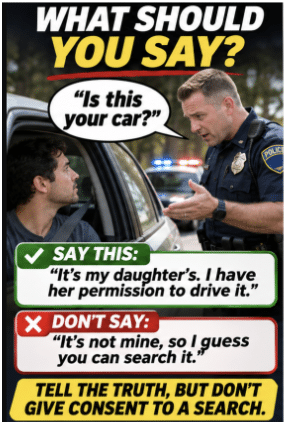
What Should You Say When Police Ask, “Is This Your Car?”
Your answer should be truthful, brief, and accurate.
Suppose you’re borrowing your daughter’s SUV with her permission.
A reasonable response is:
“It’s my daughter’s. I have her permission to drive it.”
That establishes two important facts: who owns the vehicle and why you’re driving it.
You don’t need to invent ownership. You also don’t need to volunteer your family’s entire transportation history.
And there’s another misconception worth clearing up.
Simply saying “It’s not mine” does not automatically surrender your constitutional rights.
There’s no constitutional trapdoor beneath the driver’s seat.
Your actual relationship to the vehicle matters. A particular sentence cannot create lawful possession where none exists.
Likewise, acknowledging someone else’s ownership doesn’t automatically eliminate your legitimate privacy interests.
What If an Indiana Police Officer Asks Permission to Search?
This is where the distinction becomes especially important.
Permission to drive a vehicle and consent to a police search are separate matters.
Suppose the officer asks, “Mind if I take a look inside?”
If you don’t want to authorize a search, you can respond:
“I don’t consent to searches.”
That’s it.
You don’t need to apologize or deliver a constitutional law lecture beside the interstate.
Declining consent does not guarantee police will leave the vehicle untouched. Officers may have another lawful justification, including probable cause.
But there’s no reason to turn uncertainty about ownership into voluntary permission.
During an Indiana traffic stop, keep these practical rules in mind:
- Provide the documents you’re legally required to produce.
- Answer accurately if you choose to explain your permission to drive.
- Clearly state your refusal if you don’t consent to a search.
- Follow lawful police orders and never physically interfere with officers.
If police search anyway, don’t attempt to stop them physically. The legality of that search can be examined afterward.
What If You’re Driving a Rental Car but Aren’t an Authorized Driver?
Under Byrd, being absent from a rental agreement does not automatically eliminate your Fourth Amendment protections.
However, that doesn’t mean rental agreements are meaningless.
Violating a rental company’s driver restrictions can create contractual, insurance, and financial problems.
The Supreme Court also recognized that fraudulent possession could present a very different legal situation.
The practical solution is simple: Get added as an authorized driver when the rental agreement requires it.
A few minutes at the rental counter is considerably better than having your attorney explain your rental arrangement to a federal judge.
Do Passengers Have Fourth Amendment Rights During Traffic Stops?
Yes, but passenger rights differ depending on what police are doing.
In Rakas v. Illinois (1978), the Supreme Court considered passengers challenging a vehicle search.
The passengers hadn’t established a legitimate privacy interest in the glove compartment or area beneath a seat.
Their presence in the vehicle alone wasn’t enough to challenge searches of those areas.
But a different Supreme Court case established another important protection.
In Brendlin v. California (2007), the Court held that passengers are also seized during traffic stops.
That means a passenger can challenge the constitutionality of the stop itself.
A passenger’s personal bag may raise additional privacy questions.
The important distinction is whether police violated a protected interest belonging to that particular person.
What Happens If Police Search Your Borrowed Car Without Consent?
An unlawful vehicle search may provide grounds to challenge evidence in a criminal case.
But a successful challenge depends on the facts.
An Indiana criminal defense attorney may need to examine:
- Whether the original traffic stop was lawful.
- Whether you had lawful possession or control of the vehicle.
- Whether you consented to the search.
- Whether police had probable cause or another lawful justification.
These questions can determine whether evidence obtained during a search may be used in court.
The Supreme Court’s decision in Byrd gives drivers an important constitutional argument. It does not guarantee that every search of a borrowed vehicle will be unlawful.
The bottom line is simple: You can tell the truth, respect law enforcement, and decline consent to a search.
Those rights are not mutually exclusive.
If you or a loved one are facing criminal charges following a vehicle search in Indianapolis or elsewhere in Indiana, contact the Marc Lopez Law Firm at 317-632-3642 to speak with a lawyer today.
And remember—always plead the 5th.