
A domestic battery charge in Johnson County can bring immediate restrictions, including a no-contact order. That order can affect your spouse, children, home, and daily life. Violating it can create a separate invasion-of-privacy charge, making an already serious criminal case significantly more complicated.
What does a no-contact order mean after a Johnson County domestic battery arrest?
A no-contact order means exactly what it sounds like: no contact.
Depending on the court’s order, you may be prohibited from contacting the alleged victim directly or indirectly. In a domestic case involving children, restrictions may also affect contact with the children.
Do not assume that “contact” only means showing up in person. Depending on the terms of the order, prohibited contact can include:
- Text messages
- Phone calls
- Emails
- Letters
- Social-media messages
- Contact through another person
- Going to the protected person’s home
- Approaching the person in public
If the protected person calls you, that does not necessarily give you permission to answer. The court’s order controls until the court changes it.
Indiana Code § 35-46-1-15.1 makes knowingly or intentionally violating certain protective and no-contact orders the crime of invasion of privacy. The offense is generally a Class A misdemeanor. A prior qualifying conviction can elevate it to a Level 6 felony.
Can one text message violate an Indiana no-contact order?
Yes. A single prohibited communication can potentially support an invasion-of-privacy charge.
This is where people can make a bad situation much worse.
Maybe you want to discuss the kids. Maybe there is a mortgage payment due. Maybe you want to apologize. None of those reasons automatically override a court order.
If you send repeated prohibited messages, prosecutors may pursue separate allegations based on separate acts. Indiana judicial guidance also recognizes that prosecutors may file invasion-of-privacy charges and seek consecutive sentences in appropriate circumstances.
A Class A misdemeanor carries up to one year in jail and a fine of up to $5,000.
Three texts can create a much bigger problem than one original case. Don’t turn a difficult case into several cases because you wanted to send a message.
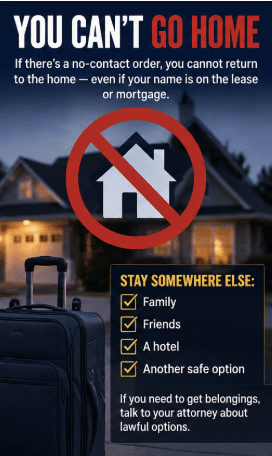
Can I go home if the alleged victim lives there?
Not if doing so would violate the no-contact order.
That can be extremely frustrating. Your clothes may be there. Your belongings may be there. Your name may even be on the mortgage or lease.
None of that gives you permission to ignore the court’s order.
You may need to stay with family, friends, or somewhere else temporarily. If belongings need to be retrieved, talk with your lawyer about lawful options rather than improvising.
The safest rule is simple: do not create your own exception to a court order.
Can domestic battery become a felony if a child was present?
Yes. Indiana domestic battery can become a Level 6 felony when specific requirements involving a child are satisfied.
Under Indiana Code § 35-42-2-1.3, domestic battery generally begins as a Class A misdemeanor. The offense can become a Level 6 felony when an adult commits domestic battery in the physical presence of a child under 16, while knowing the child was present and might see or hear the offense.
A Level 6 felony carries between six months and two-and-a-half years, with an advisory sentence of one year.
The details matter. “A child was somewhere nearby” is not the entire legal test.
What evidence matters in a Johnson County domestic battery case?
Domestic battery cases often turn on context rather than one isolated accusation.
Indiana law does not require a visible injury for basic domestic battery. Indiana Code § 35-42-2-1.3 covers knowingly or intentionally touching a family or household member in a rude, insolent, or angry manner.
A defense attorney may examine evidence such as:
- Photographs showing injuries or the absence of expected injuries
- Body-camera footage
- 911 recordings
- Statements from the alleged victim
- Statements from witnesses
- Conflicting accounts of what happened
- Medical records
- The physical scene
- Evidence concerning who initiated the confrontation
Self-defense may also become relevant in the right circumstances. If the other person swung first, for example, the sequence of events can become critical.
This is why details matter. A claim that someone was struck repeatedly may look different when photographs, witnesses, or recordings tell another story.
What can I do to improve my position while the case is pending?
Start by following every court order.
After that, mitigation may involve addressing whatever underlying issue contributed to the situation. Depending on the circumstances, that could include:
- A batterer’s intervention or domestic violence program
- Mental-health counseling
- Alcohol or substance-use treatment
- Stable housing
- Consistent employment
- Compliance with bond conditions
- Avoiding new criminal charges
Taking appropriate steps does not necessarily mean admitting guilt. Mitigation and defending the allegations are different parts of a criminal case.
The point is to give your attorney something useful to work with. Following the no-contact order is one of the simplest ways to avoid making the prosecutor’s case stronger.
Can I still see my children while a no-contact order is in place?
Possibly, but never assume you can arrange contact yourself.
If children are covered by the order, contact may require court approval or a modification. In some cases, an attorney may explore structured arrangements involving relatives or another approved setting.
Until the order changes, however, follow it as written.
Do not use a child, grandparent, friend, or other relative as a messenger if indirect communication is prohibited. Trying to work around the order can create exactly the problem you were trying to avoid.
Why does local experience matter in a Johnson County domestic battery case?
Criminal cases are governed by Indiana law, but local courtroom practices still matter.
Domestic battery cases in Johnson County can involve prosecutors who regularly handle domestic violence allegations. No-contact violations can also affect negotiations because they give the State new allegations to consider.
The same principle applies if a case eventually results in probation. Violating probation can expose a defendant to additional consequences, including possible incarceration.
A strong defense therefore involves two things at once: challenging the State’s evidence and avoiding preventable mistakes while the case is pending.
If you have been charged with domestic battery in Johnson County, Indiana, contact the Marc Lopez Law Firm at 317-632-3642 to speak with a lawyer today.
And remember—always plead the Fifth.