
Yes, police can ask additional questions after an Indiana traffic stop ends. But the conversation must generally be voluntary. Without independent reasonable suspicion, officers cannot continue detaining you solely to investigate unrelated crimes. You can ask whether you’re free to leave and refuse consent to a vehicle search.
By Attorney Marc Lopez | Marc Lopez Law Firm
Imagine getting pulled over for a routine traffic violation. The officer checks your license, writes a warning, and hands back your documents.
He shakes your hand and says, “Have a safe trip.”
Then something interesting happens.
The officer walks away, turns around, and leans back into your window.
“Hey, real quick. You seem nervous. Anything in the car I should know about?”
What looks like harmless small talk may actually be an attempt to begin a second investigation.
And depending on what happens next, your Fourth Amendment rights may be at stake.
When Does a Traffic Stop Legally End in Indiana?
A traffic stop generally ends when the officer completes the tasks related to the original traffic violation.
In Rodriguez v. United States, 575 U.S. 348 (2015), the U.S. Supreme Court established an important Fourth Amendment rule.
Police cannot prolong a traffic stop for an unrelated investigation without independent reasonable suspicion.
The ordinary responsibilities of a traffic stop include:
- Checking your driver’s license.
- Verifying registration and insurance.
- Checking for outstanding warrants.
- Addressing the traffic violation.
- Handling related roadway and officer-safety concerns.
Once these tasks are completed, or reasonably should have been completed, the stop’s original justification expires.
An officer cannot deliberately slow down the paperwork just to buy time for a drug investigation.
And a handshake does not give police permission to start another detention.
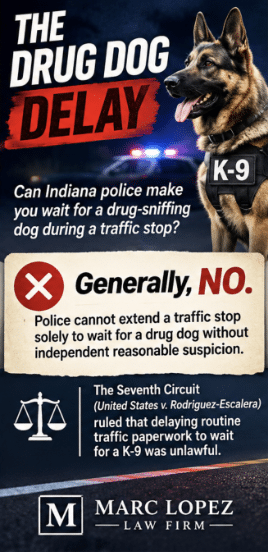
Can Police Make Me Wait for a Drug Dog During an Indiana Traffic Stop?
Generally, police cannot extend a traffic stop solely to wait for a drug-sniffing dog without reasonable suspicion.
The Seventh Circuit Court of Appeals addressed this issue in United States v. Rodriguez-Escalera, 884 F.3d 661 (7th Cir. 2018).
An Illinois state trooper stopped a vehicle on Interstate 70.
After approximately 11 minutes, the officer had enough information to complete the traffic citations.
Unfortunately for the officer, the department’s drug dog was busy somewhere else.
The trooper spent nearly 22 minutes writing three routine citations while waiting for the K-9 unit.
The dog arrived 33 minutes into the stop. It did not alert to drugs.
Police nevertheless searched the vehicle and discovered methamphetamine.
The Seventh Circuit upheld the suppression of that evidence because the detention had been unlawfully prolonged.
The Seventh Circuit covers Indiana, Illinois, and Wisconsin. Its Fourth Amendment rulings are particularly relevant to Indiana criminal cases.
A department’s scheduling problem does not eliminate a driver’s constitutional rights.
Does Acting Nervous Give Indiana Police Reasonable Suspicion?
Nervousness alone generally does not establish reasonable suspicion of criminal activity.
The Indiana Supreme Court addressed this issue in Finger v. State, 799 N.E.2d 528 (Ind. 2003).
The Court explained that nervous behavior, standing alone, carries little weight when evaluating reasonable suspicion.
Why? Because ordinary people get nervous around police officers.
Your hands might shake. Your voice might crack. You might avoid eye contact.
None of those behaviors automatically means you’re committing a crime.
Other circumstances can contribute to reasonable suspicion. Courts examine the complete situation, not one isolated observation.
But looking nervous is not a blank check for an extended traffic stop.
What Happens If an Officer Says “Hang Tight” After Giving Me a Warning?
Those seemingly harmless words can turn a voluntary conversation into an unlawful detention.
Consider United States v. Bowman, 884 F.3d 200 (4th Cir. 2018).
A North Carolina trooper stopped Brian Bowman for traffic violations.
The trooper issued a warning, returned Bowman’s documents, and shook his hand.
The traffic stop was complete.
The officer then asked to continue talking. Bowman initially agreed.
But when the trooper left to question Bowman’s passenger, he told Bowman to remain in the patrol car.
“Just hang tight right there, okay?”
The Fourth Circuit determined that Bowman was detained at that point without adequate legal justification.
The court vacated his methamphetamine conviction and ordered further proceedings.
Although this ruling came from another federal circuit, it illustrates an important constitutional distinction.
A request to speak voluntarily is different from an order to remain.
Is the Police “Two-Step” Traffic Stop Tactic Legal?
The maneuver itself is not automatically unconstitutional. Its legality depends on whether the resulting encounter remains voluntary.
The Kansas Highway Patrol developed a practice commonly called the Kansas Two-Step.
Troopers would:
- Complete a routine traffic stop.
- Return the driver’s documents.
- Wish the driver a safe trip.
- Walk several steps away.
- Turn around and request another conversation.
In Shaw v. Smith (10th Cir. January 29, 2026), the Tenth Circuit examined this practice.
The court recognized evidence of unconstitutional detention practices involving interstate drivers.
However, it declined to prohibit the Two-Step maneuver categorically.
Here’s the distinction that matters: Police may request a voluntary conversation, but they cannot simply manufacture authority to detain you.
Whether a reasonable person would feel free to end the encounter is central to that question.
What Should I Say If an Officer Keeps Questioning Me After a Traffic Stop?
The safest approach is to remain calm, avoid unnecessary explanations, and clearly communicate your wishes.
You do not need to provide a detailed autobiography about your travel plans.
Consider these statements:
- “Officer, am I free to go?” This asks whether the detention has ended.
- “Am I being detained?” Ask this if the answer remains unclear.
- “I do not consent to searches.” This clearly declines permission for a voluntary search.
- “I do not wish to answer questions. I want a lawyer.” This communicates your decision not to participate in additional questioning.
If the officer confirms you’re free to leave, depart calmly and safely.
If you’re ordered to remain or exit the vehicle, do not physically resist.
You can challenge an unlawful detention later without creating another problem on the roadside.
Remember that refusing consent does not prevent every search. Police may have an independent legal basis.
Can Evidence Be Thrown Out If Indiana Police Illegally Extend a Traffic Stop?
Yes. Evidence obtained through an unconstitutional detention may be excluded through a motion to suppress.
A criminal defense attorney can examine the timing and circumstances of the stop.
Body-camera recordings, dash-camera footage, dispatch records, and officer testimony may all be relevant.
Another Seventh Circuit case demonstrates that these rights matter even when police find nothing.
In Huff v. Reichert, 744 F.3d 999 (7th Cir. 2014), two travelers were returning from a Star Trek convention.
After receiving a warning, they were detained for approximately 34 additional minutes.
Police searched their vehicle but documented no contraband.
The Seventh Circuit rejected the officer’s request for qualified immunity at that stage, allowing the civil-rights case to continue.
An unconstitutional detention can have legal consequences even without a criminal conviction.
What Should I Do If an Indiana Traffic Stop Leads to Criminal Charges?
A traffic ticket does not give police unlimited authority to investigate unrelated crimes.
The difference between a voluntary conversation and an illegal detention can determine whether critical evidence is admissible.
If a traffic stop in Indianapolis or elsewhere in Indiana resulted in criminal charges, the circumstances deserve careful review.
Contact the Marc Lopez Law Firm at 317-632-3642 to speak with a lawyer today about your legal options.
And remember—always plead the 5th.